

All golfers should engage in strength training to help get the most out of their golf game.
However, golfers over the age of 50 in particular should really consider starting a legitimate strength training program to offset sarcopenia, the process of age- related loss of muscle mass.
I’ve previously discussed the principles of strength training and talked about the primary exercises involved and typical number of reps involved.
It’s now time to get on with the training program itself.
What follows is the initial phase of what we describe as the Novice Linear Progression (NLP).
During the NLP, the trainee is able to experience gains in strength reflected in their ability to add weight to the bar nearly every workout.
When the NLP concludes, the trainee moves on to intermediate, more complex training, and the goal becomes simply to continue building strength, but more slowly.
Let’s get to Phase 1.
Phase 1 strength training for golfers
The trainee who is starting off their training for the first time ever, or after a significant period of time has elapsed since they previously trained, starts with a very basic program that trains three days per week.
This is also the case with older trainees over 60 and even 70, for this initial Beginner training.
You will want to set up a schedule that gives you at least one day of rest between workouts, such as Monday, Wednesday and Friday.
Older Trainees over 60, after a couple months, may then want to switch to a two day per week schedule, such as Monday and Thursday, as it becomes more difficult to recover between workouts.
This initial program consists of two basic workouts as follows:
Workout A Workout B
Barbell Squat Barbell Squat
Bench Press Overhead Press
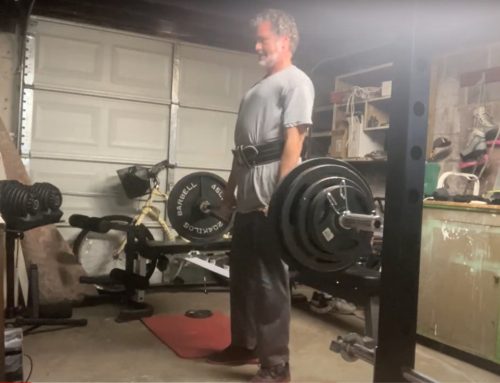
Deadlift Deadlift
The recommended type of barbell squat is what we refer to as the low bar squat. The low bar squat has the bar sitting just below the upper trap muscles, rather than on top of the shoulders.
At the bottom of this post are four videos taken from the Starting Strength Youtube channel that demonstrate precisely how to perform each of these lifts.
Note: The low bar squat requires flexibility in the shoulders, and can put pressure on the elbows. The high bar squat is a suitable alternative (this is where the bar rests on top of the shoulders), but can put more pressure on the knees. If you have some issues, a safety squat bar may be warranted. Some people may simply want to incorporate a leg press machine. However, that is a far less effective exercise than the low bar squat.
Sets and Reps for Phase 1
For the squat, bench press and overhead press, we want to perform three working sets of five reps.
For the deadlift, we will only want to do one working set of five reps.
Before we do any working sets, we want to warm up first.
I recommend getting the body warm by jogging in place and doing some jumping jacks for a couple minutes, followed by some light stretching.
With each of the lifting exercises, we then want to perform a few warm up sets with a focus on our form, before getting to the working sets.
Sample Workout – Bench Press
Set 1 – Empty Bar – 10 reps with focus on form
Set 2 – 100 pounds – 5 reps
Set 3 – 115 pounds – 3 reps
Set 4 – 135 pounds – 1 rep
Set 5 – 145 pounds – 1 rep
Set 6 – 155 pounds – 1 rep
Sets 7-9 – 175 pounds – 5 reps
For the warm up sets, you only rest for the time it takes to change the weight on the bar. For the three working sets, you will rest for about 2 to 3 minutes.
If you start out very conservatively with your weights, then 2 minutes is all you should need for the first few weeks of training.
Sample Workout – Deadlift
Set 1 – 135 pounds – 5 reps
Set 2 – 155 pounds – 3 reps
Set 3 – 175 pounds – 1 rep
Set 4 – 195 pounds – 1 rep
Set 5 – 205 pounds – 1 rep
Set 6 – 225 pounds – 5 reps
Note – It is critical that you start out very conservatively, otherwise, you will stop progressing too quickly. Do not get greedy and start adding too much weight to the bar for each workout… stick with five pounds or less, particularly if you are over 50.
For the first couple of weeks, you should be able to easily complete 5 reps for 3 sets for each exercise, adding weight to the bar with each workout.
To determine your starting weights, please check out the last video at the bottom of this page that describes the process.
How much rest between sets?
Early on in your training, you should be able to complete all three sets of five reps with two minutes of rest between sets.
As the weight on the bar gets heavier, you will find that you will need more rest.
Remember this… your goals is to complete all five reps for each set. Therefore, rest longer if you have to.
In the case of the squat, if you really start training with heavier weight, you’ll find that you will need five minutes or more between sets. That comes down the road in a future phase of your training.
Adding Weight in Phase 1
For a couple of months, you should be able to add weight to the bar for each exercise for each workout, IF you start conservatively AND you don’t get too greedy and try to add weight too quickly.
Nothing will stall out your progress more quickly than adding too much weight too quickly.
In general, most people can add 5 pounds to the bar for the first couple of weeks, and perhaps the first month.
After that, many trainees should consider just adding 2.5 pounds each workout to let the NLP run for as long as possible.
At some point, that 5th rep in the last set will take a little longer to complete than the first four reps.
That will be your signal to start adding weight in smaller amounts.
This is where micro weight plates will come into play (be sure to check out the Recommended Equipment Page).
The overhead press is where this process begins first, and typically within about 6 to 8 weeks after starting the NLP. Therefore, you should consider getting a set of micro weight plates at the start of your training.
Keep this in mind… this is a marathon and not a sprint. Just stick to the program and you will get much stronger much more quickly than you ever thought possible.
With that said, in order to continue adding weight to the bar when the weight is getting heavy, you MUST eat and get enough sleep.
It is not the weightlifting that will make you stronger… it is the RECOVERY.
If you are trying not to gain too much weight, then you will need to pay close attention to your diet and your macros.
Protein consumption is an absolute must, so if you don’t want to gain unwanted fat, you’ll need to pay attention to total calorie consumption.
Strength training for golfers Phase 1 final thoughts
As mentioned, please check out the videos below to learn how to perform the lifts and determine your starting weights.
If you think you need a bit more guidance, or some ideas for alternative exercises, etc., you may want to consider my help.
Now, get to work!
This next video discusses how to determine your starting weights for each of these lifts.

Author: Scott
Discover more from Scott Cole Golf
Subscribe to get the latest posts sent to your email.






Leave A Comment