
 A solid short game will go a long way toward helping you lower your scores, yet it is probably the part of the game that golfers spend the least amount of time practicing.
Head over to any practice facility that offers a driving range and short game area/practice green, and you will find many more golfers on the driving range.
With that said, putting and short game practice should make up at least 50% of your practice time.
Not only will your short game help you make up for bad shots off the tee or bad approaches to the green, it will help you capitalize on your good shots as well.
The key is to know how to practice so you can make the most of your valuable time.
First, though, we need to consider how to make the right decisions around the green, and that is the focus of this post.
Decisions around the green
When you miss the green with your approach shot, you are typically left with four options.
- Putting
- Chipping
- Pitching
- Bunker shot
Option #1 should always be the putting technique, because it is the easiest method to control the distance and direction the ball travels.
In putting, the critical fundamentals your student needs to master are:
- Reading the break
- Starting the ball on the intended line
- Hitting the ball consistently in the same spot on the putter face
- Rolling the ball the correct distance
Therefore, when you have the opportunity to use your putter, do it!
This is often the case when you miss the green and your ball is still situated on fairway length grass, with no heavier grass or other obstacles between you and hole.
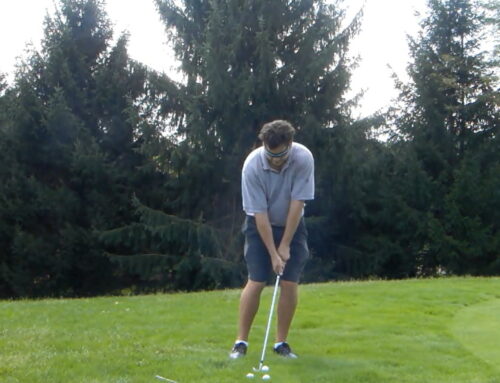
Option #2 is chipping because the ball “flies” a short distance and the ball rolls like a putt when it lands.
The chipping technique is similar to putting except that the setup must be slightly adjusted to hit the ball solidly on the club face.
The purpose of the chipping setup adjustments is to create a steeper angle of approach that moves the bottom of the swing forward to hit the ball solidly. I’ll get to the mechanics of chipping down the road.
Option #3 is pitching. This is when you need to get the ball in the air for a greater distance, and with some back spin.
By definition, the pitch is a lofted shot used mostly to fly the ball near the target and stop quickly when it hits the green.
Option #4 is a bunker shot. Now, it is possible to putt and chip from a bunker if the situation warrants, but in this regard we are referring to the need for technique specific to the greenside bunker, which is usually a higher, spinning shot than a pitch shot.
Poor decisions around the green
Many golfers lose shots around the green due to poor decisions. Usually this involves hitting a chip shot when a putt will do, or hitting a pitch shot when a chip shot will do.
In other words, they opt for the more difficult shot, execute it poorly and fail to get up and down.
The most common error is to hit a pitch shot instead of opting for a chip shot. This is when you see chunks, thin shots skulled across the green and shanks.
Quick rules of thumb on what option to choose…
- If your ball sits on fairway length grass that is kept cut fairly low, and the topography is somewhat level then you should putt
- If your ball sits on fairway length grass, but it is not cut that low, you should probably chip
- If your ball sits in the rough and you have short distance to carry onto the green, then you should likely hit a chip shot
- The exception to the above is if the hole is cut to the same side that you missed the green and you need to stop the ball quickly
- If you need to carry the ball over a bunker, or a large area of longer grass, you need to hit a pitch shot, or possibly even a flop shot
If you are not a single digit handicap or better golfer, your initial goal for difficult pitch shots and bunker shots is just to get the ball on the green so you can putt.
Over time, as you practice and learn to execute these shots better, you can worry about hitting the ball closer to the hole.
Final Thoughts
As I mentioned, all golfers need to practice their putting and short game for at least 50% of their practice time.
I would also recommend not practicing on the range and working on the short game during the same session.
Hitting a big bucket of balls on the range and then heading over to the practice green will leave you less focused due to fatigue.
Therefore, split up your range and short game sessions.
Be sure to head over to the Start Here page to check out some of the technique ideas I present. Also, at the bottom of that page is a link devoted to Brad Faxon’s short game videos presented on Golf Channel years ago.
By the way, if you haven’t signed up for my newsletter, fill out the form below!

Author: Scott
Discover more from Scott Cole Golf
Subscribe to get the latest posts sent to your email.